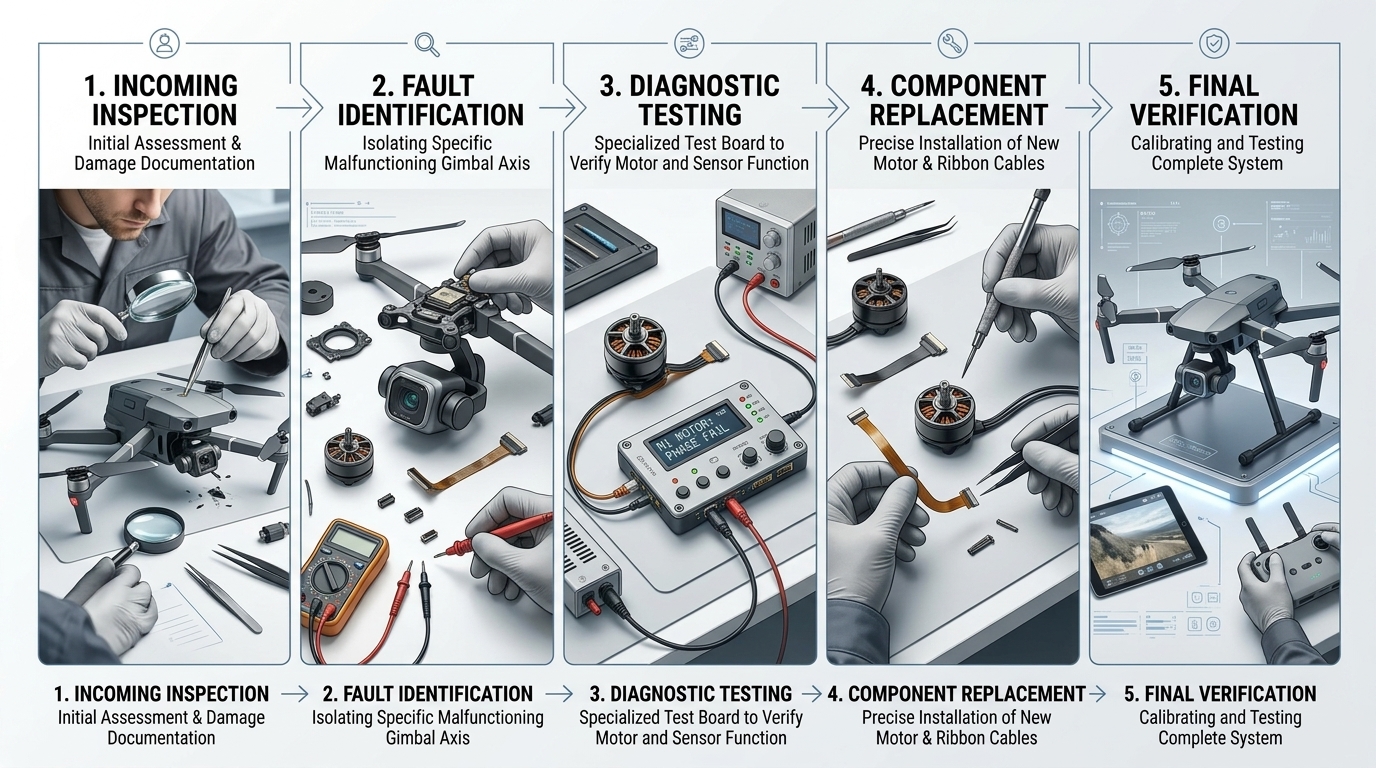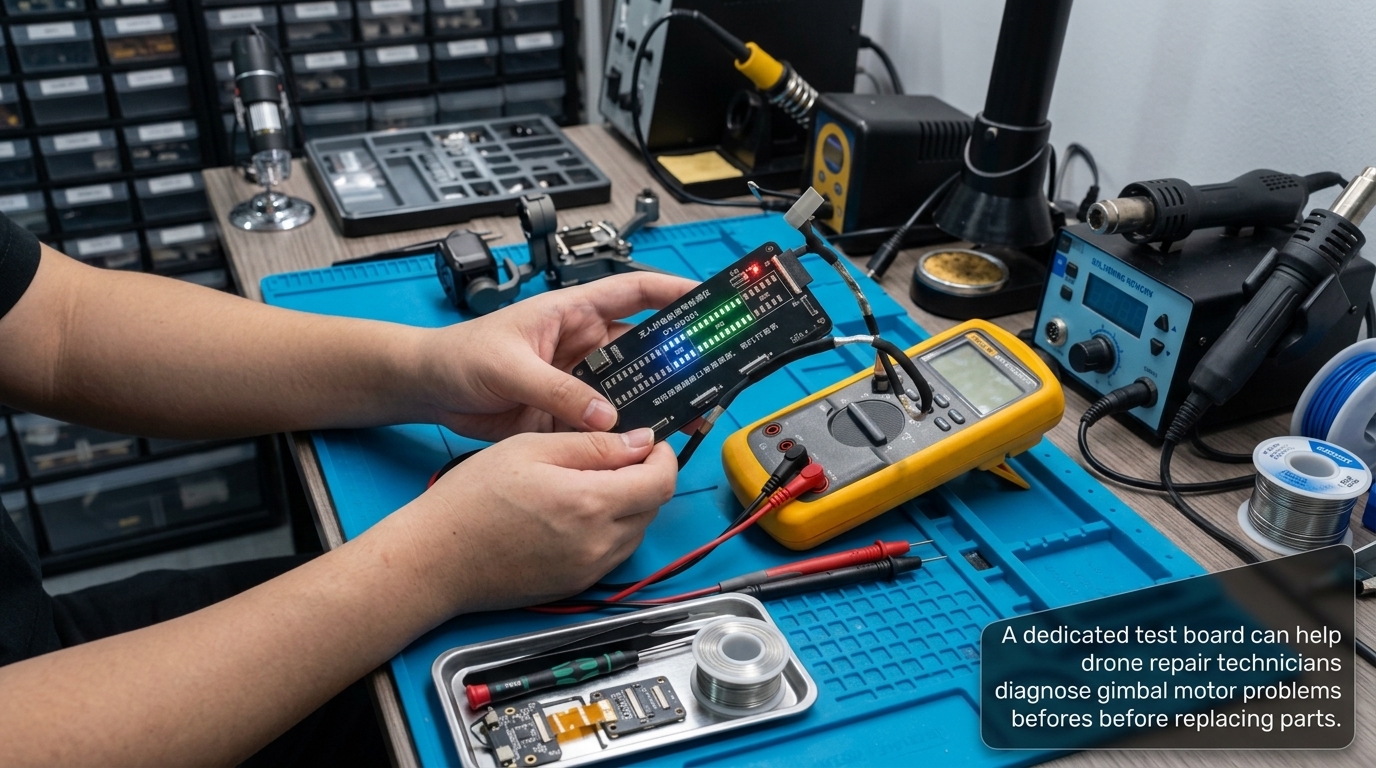
When a damaged drone arrives at a repair shop, the first question is usually simple:
What is actually broken?
A gimbal may shake. A camera may fail to initialize. A motor may stop moving. The drone may show a gimbal overload warning.
But these symptoms do not always mean that the motor itself is defective.
A damaged ribbon cable, loose connector, mechanical obstruction, impact damage, or another gimbal component can sometimes create very similar symptoms.
This is where a drone test board becomes useful.
For repair shops handling DJI drones regularly, a dedicated test board can turn a trial-and-error repair process into a much more controlled diagnostic workflow.
A drone test board is a specialized diagnostic tool used to test individual components outside the complete drone system.
For gimbal repair, a gimbal motor test board can be used to evaluate the motor's response and help technicians determine whether the motor is likely to be functioning correctly.
Modern drone gimbals typically use multiple motor axes, including:
Each motor has a different job, but a failure in any one of them can affect the performance of the entire camera stabilization system.
Instead of reinstalling a motor into the complete gimbal and then powering up the drone to see what happens, a compatible test board can provide a more direct way to check the motor.
For example, DJIDrone-Parts currently offers a Gimbal Motor Test Board for DJI Matrice 4 Series, designed for testing Yaw, Pitch, and Roll gimbal motor systems. The product is positioned for drone repair technicians, maintenance workshops, and professional repair environments.
For a step-by-step guide to using a DJI gimbal motor test board, read our How to Use a DJI Gimbal Motor Test Board guide.
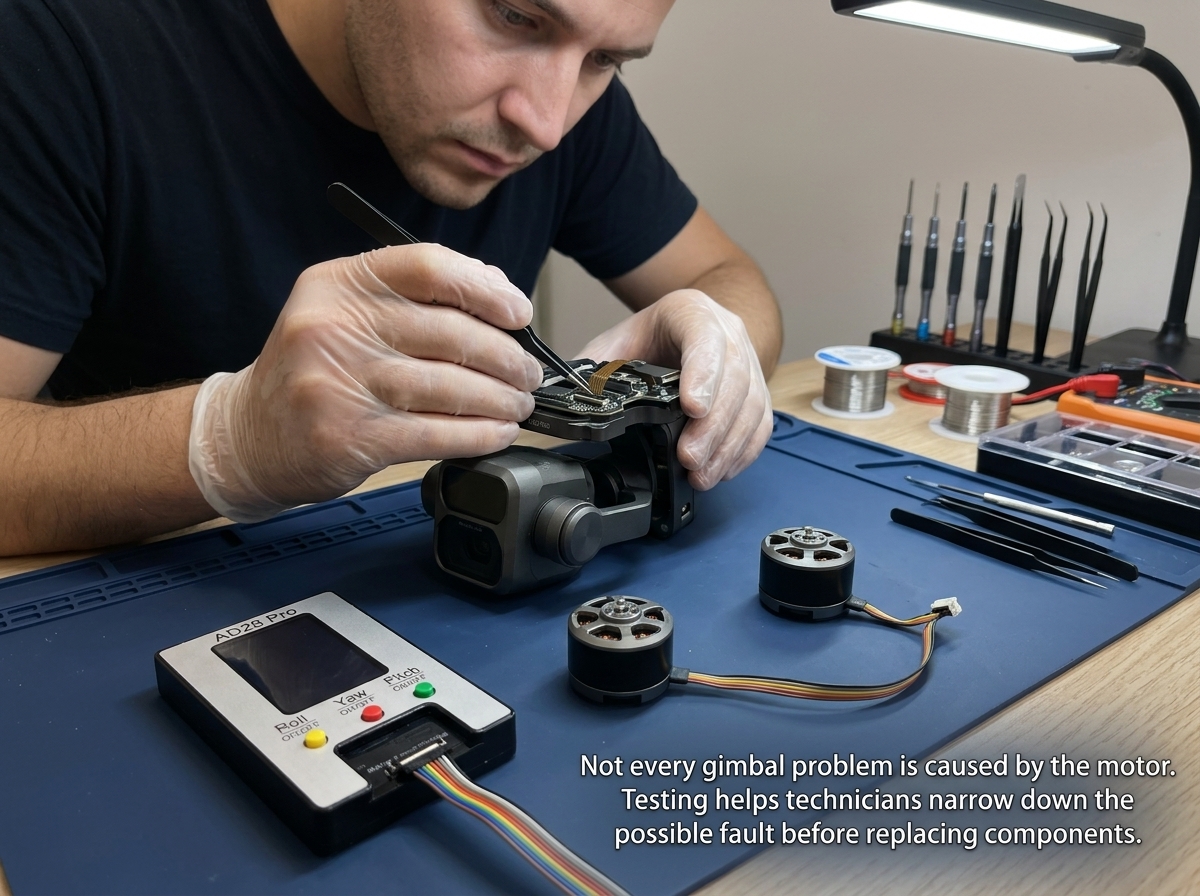
One of the most common problems in repair work is replacing a component before confirming that it is actually the cause of the failure.
Imagine a drone arrives with a shaking camera.
The technician assumes that the gimbal motor is damaged and replaces it.
The camera still shakes.
Now another component has to be checked.
That means more labor, more parts consumed, and more time spent on a single repair.
A test-first workflow is different.
Instead of immediately replacing the motor, the technician can:
Inspect → Test → Diagnose → Replace → Reassemble → Final Test
This approach does not eliminate every possible diagnosis error, but it gives the technician more information before making a replacement decision.
For a repair shop processing multiple drones each week, that difference can become significant.
Time matters in a repair business.
A technician may already know that a drone has a gimbal problem, but identifying the exact failed component can take considerably longer.
A test board can help isolate the motor from the rest of the drone.
Rather than repeatedly assembling and disassembling the complete gimbal just to see whether the motor responds correctly, the technician can perform a more focused test.
This is especially useful when dealing with:
The goal is simple:
Find the problem before spending more time replacing parts.
Not every gimbal problem is a motor problem.
A technician should also consider:
DJIDrone-Parts' existing gimbal repair guide also emphasizes checking the motor together with cables, connectors and mechanical components instead of assuming the motor is always the source of the problem.
This is one of the biggest reasons a test board can be useful.
A replacement part costs money.
A replacement part that was never needed costs money and adds extra labor.
For a repair shop, better diagnosis can therefore help control both repair time and parts consumption.
A replacement motor may look perfect when it arrives.
That does not mean a technician should automatically install it and complete the whole repair before testing.
A better approach is to verify the component first whenever the compatible test equipment and repair procedure allow it.
For example:
New motor → Test → Confirm response → Install → Reassemble → Final drone test
This gives technicians another checkpoint in the repair process.
It can be particularly useful for repair shops that keep multiple replacement motors and other gimbal components in stock.
A professional repair shop should not rely completely on individual technician experience.
A repeatable workflow is easier to train, easier to manage, and easier to scale.
A simple gimbal repair workflow could look like this:
Record the reported symptoms.
Check the gimbal, cables, connectors, housing and signs of impact or liquid damage.
Determine whether the Yaw, Pitch or Roll system needs further inspection.
Use a compatible test board to evaluate the suspect motor.
Compare the test result with the physical condition and other symptoms.
Install the appropriate replacement part.
Reconnect the gimbal and other related components carefully.
Confirm that the repaired system functions normally.
The test board is not the entire repair process.
It is one tool inside a better process.
For a single repair, the value of a test board may not seem obvious.
But repair shops do not work on just one drone.
A workshop may handle several damaged drones in a day, with different symptoms and different gimbal configurations.
Over time, even a small improvement in diagnosis can add up.
Consider a repair shop that frequently deals with:
Camera shaking → Gimbal motor inspection → Motor testing → Part replacement → Final test
A dedicated diagnostic tool can make these repeated tasks easier to standardize.
That is why test equipment should be viewed as part of the workshop's infrastructure rather than simply another accessory.
A compatible test board can be useful when a technician needs to investigate symptoms such as:
Unexpected movement or vibration can sometimes be related to a gimbal motor, but cable, structural or other electronic problems should also be checked.
If the gimbal starts moving but cannot complete initialization, testing the motor may help narrow down the possible causes.
An overload warning does not automatically prove that the motor is defective. Mechanical obstruction, accessories, movement restrictions and hardware problems can all be relevant considerations.
A physically damaged drone may have several affected components. Isolating the motor can help determine whether it is worth replacing.
A test board can also be useful when checking a replacement component before completing the final assembly.
This point is important.
A test board should not be treated as a magic diagnostic device.
A good technician still needs to inspect the entire gimbal system.
Before connecting a motor to a test board, check:
The exact connection method and test procedure also depend on the specific board and drone model.
Different drone generations may use different connectors and gimbal systems, so compatibility should always be confirmed before use. DJIDrone-Parts' own product documentation specifically identifies its Matrice 4 test board as being designed for the DJI Matrice 4 series.
Not every test board works with every drone.
Before ordering one, check the following:
Confirm the exact aircraft model.
For example:
DJI Matrice 4T ≠ DJI Mini 3 Pro ≠ DJI Mavic 3
Similar-looking components do not necessarily mean compatible components.
Different gimbals may use different motors and connector configurations.
Confirm whether the board supports the required:
Yaw / Pitch / Roll
The connector must match the motor and board.
Always check the board's specific compatibility information before ordering.
If you are unsure which board or component you need, it is better to confirm the model and connector first instead of ordering based only on appearance.
For a hobbyist repairing one drone, a test board may be used occasionally.
For a professional repair shop, the calculation is different.
The value comes from repeated use.
The same tool can potentially be used across multiple jobs to:
Diagnose faster
Reduce unnecessary replacement
Verify replacement components
Standardize workshop procedures
Reduce repeated disassembly
Make technician troubleshooting more systematic
These benefits are particularly relevant to businesses that regularly handle DJI gimbal repairs.
DJIDrone-Parts focuses on DJI drone replacement parts and repair-related components, with product categories covering Mavic, Mini, Matrice, Air, Avata, Neo, Flip, Phantom and other drone parts.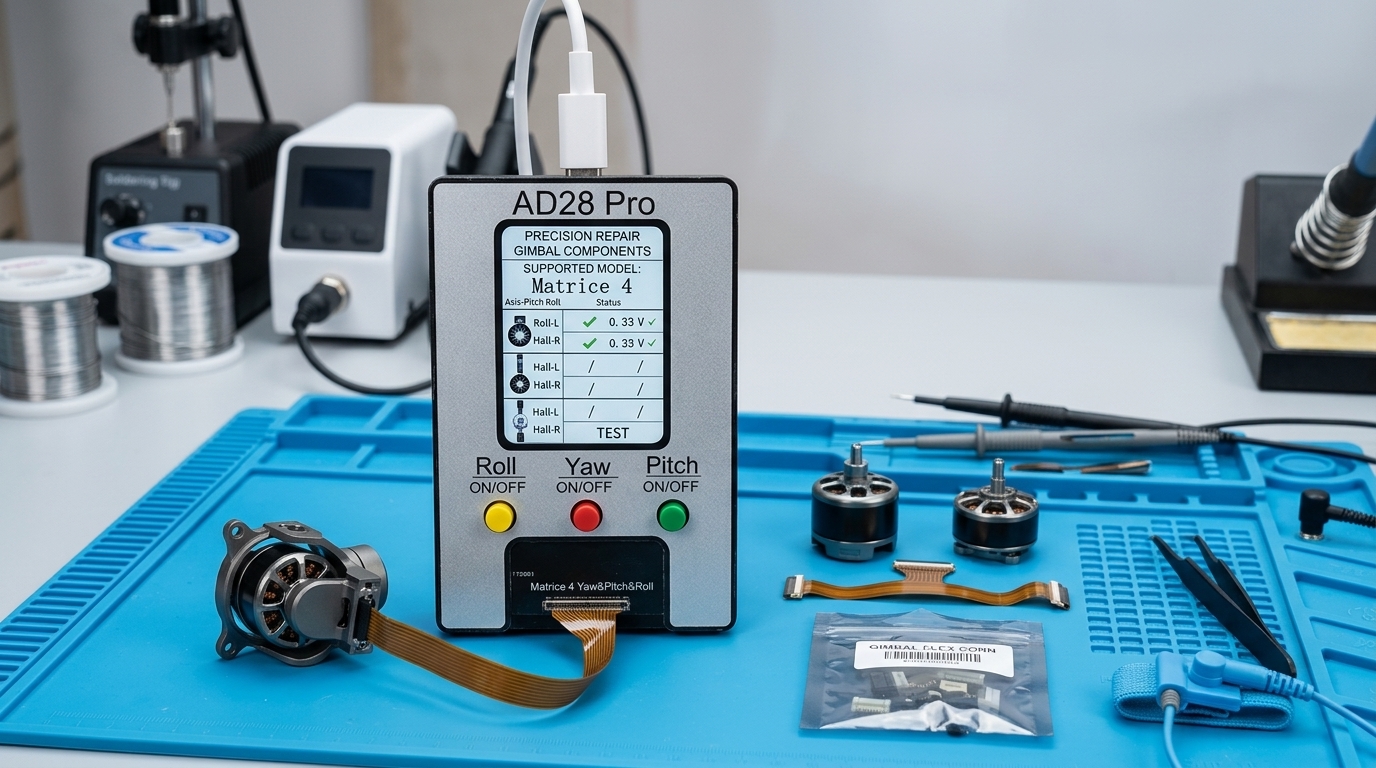
For technicians working with DJI Matrice 4 Series gimbals, the Gimbal Motor Test Board for DJI Matrice 4 Series is designed for Yaw, Pitch and Roll motor diagnostics and is currently listed on the site at $52.00.
A good repair shop does not just replace parts.
It needs to know which part actually needs to be replaced.
That is the real value of a drone test board.
For gimbal-related repairs, a compatible test board can help technicians isolate motor problems, verify replacement components and build a more consistent repair workflow.
It will not replace proper inspection or technical experience, but it can give technicians one very important advantage:
more information before making a repair decision.
For shops handling DJI drones regularly, that can mean less guesswork and a more efficient repair process.
Check the compatibility of your drone and gimbal first, then choose the appropriate testing equipment and replacement components.